
Douglas Adams's whale was a cloud
What I thought was a pretty December sky turned out to be something stranger
Early on the morning of December 16th, 2022, something appeared in the sky above West Sonoma County that looked, with a little imagination, like Douglas Adams's whale materialising out of thin air above an alien planet — elongated, luminous, faintly absurd against the dark.
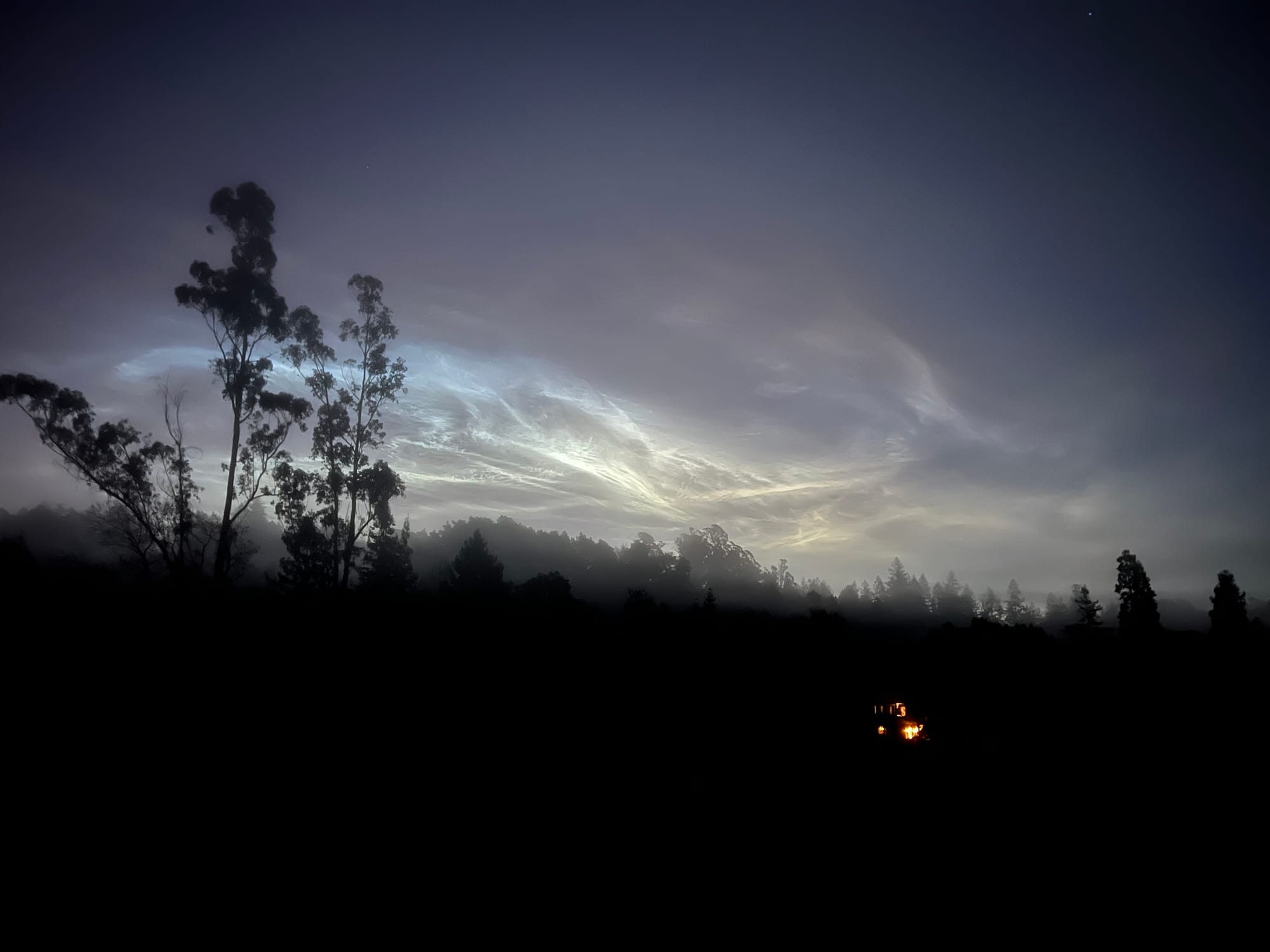
The first photograph was essentially a reflex: phone out, click. But the formation was still there, still whale-like, and a phone photograph felt inadequate — so I went back inside for the DSLR. And then I just kept going, because whatever this was, it was unlike anything I'd seen before. The wisps shifted and thinned with a slowness that was oddly hard to look away from.
For those unfamiliar with the reference (and for anyone who immediately thought of Twitter instead): in Douglas Adams's The Hitchhiker's Guide to the Galaxy, a whale is suddenly called into existence high above an alien planet, and has just enough time to become briefly acquainted with existence before the ground makes its acquaintance with it. The formation that morning had the same quality — improbable, and clearly not long for this world.
I found out later that morning, from a social media post by meteorologist Daniel Swain, that what I was looking at was genuinely unusual. It was a noctilucent cloud — one of the rarest formations there is. For me, though, it was the whale cloud and that was about it.
Three and a half years later, I uploaded a photograph of a caterpillar to Claude.
The caterpillar — a striking black and yellow thing found on a rock just west of Sebastopol — was duly identified as a likely Hemileuca eglanterina, the Sheep Moth, native to the California Coast Ranges and emphatically not something to handle. Satisfied with that, I uploaded a second photograph: a daytime sky, cirrus clouds, taken on the same walk. Anything interesting? Not particularly — textbook high-altitude cirrus, pretty but unremarkable.
Then the whale cloud. This was, if I'm honest, something of a test: I was curious whether it would be recognised for what it was.
It was.
A brief detour into atmospheric physics — pieced together from Daniel's post that morning, and filled in later via Wikipedia and Claude.
Noctilucent clouds form at around 80 kilometres up. That's not weather. That's the mesosphere: the layer of atmosphere above which most of it has run out, below which space hasn't quite begun. The clouds are visible at dawn and dusk because sunlight still reaches that altitude when the ground is in darkness. And the ice crystals themselves — far finer than those in ordinary clouds — scatter that light into the electric blue-white that makes them unmistakable.
Normally they're a high-latitude summer phenomenon — seen above 50° north or south, around the solstice, when the geometry of sunlight and darkness is right. December at 38°N should be wrong on both counts.
The explanation is that a rocket launch from Vandenberg, roughly 250 miles to the south, had deposited water vapour into the mesosphere. At that altitude, in those temperatures, it froze. And the sun, just below the horizon, lit it up.
Back to the conversation; it went in stages. The first image — the iPhone photograph — was recognised as a noctilucent cloud. On a whim, I shared a second: the one that looked most like the whale. At which point the question came back: was there any record of how the formation had evolved?
It hadn't occurred to me that the evolution mattered. "Oh, if the evolution is important, I have a third," I said — and sent the ring phase. Were there more?
There were. Nine images in total, spanning sixteen minutes: the whale at peak brightness; the plume curling back on itself into a near-perfect elliptical ring; then gradual dispersal, wisp by wisp, until the sky was just sky again.
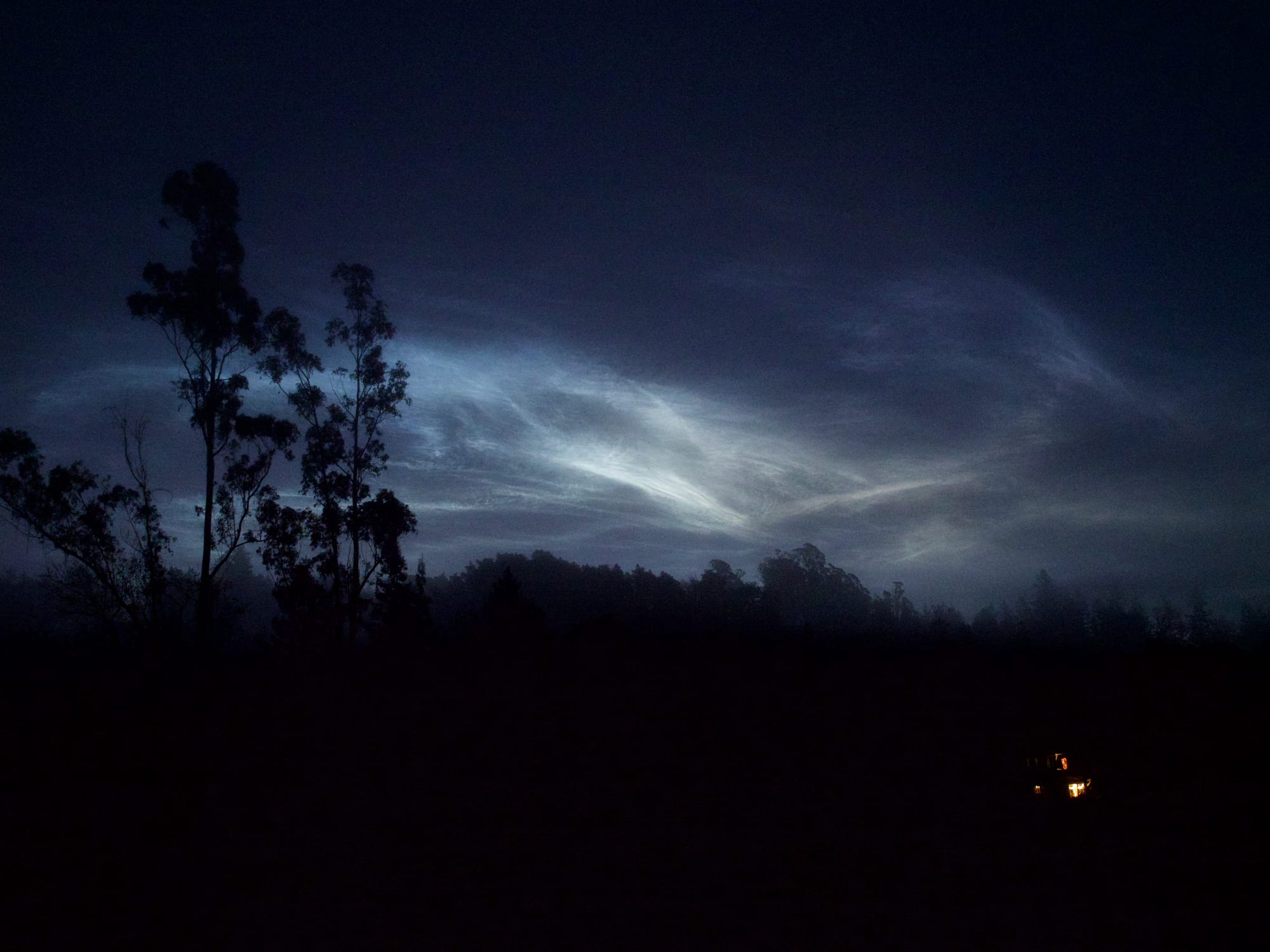
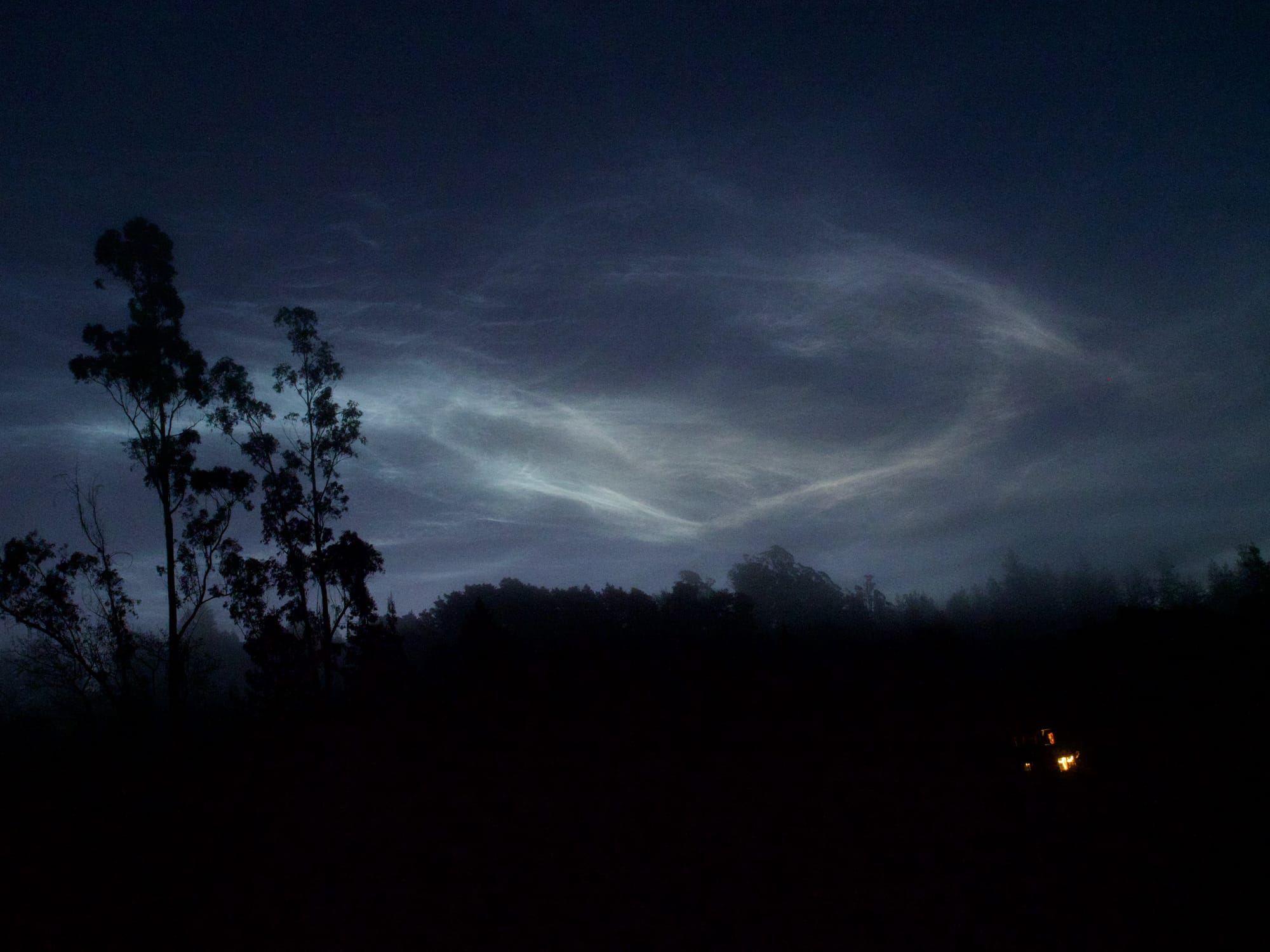
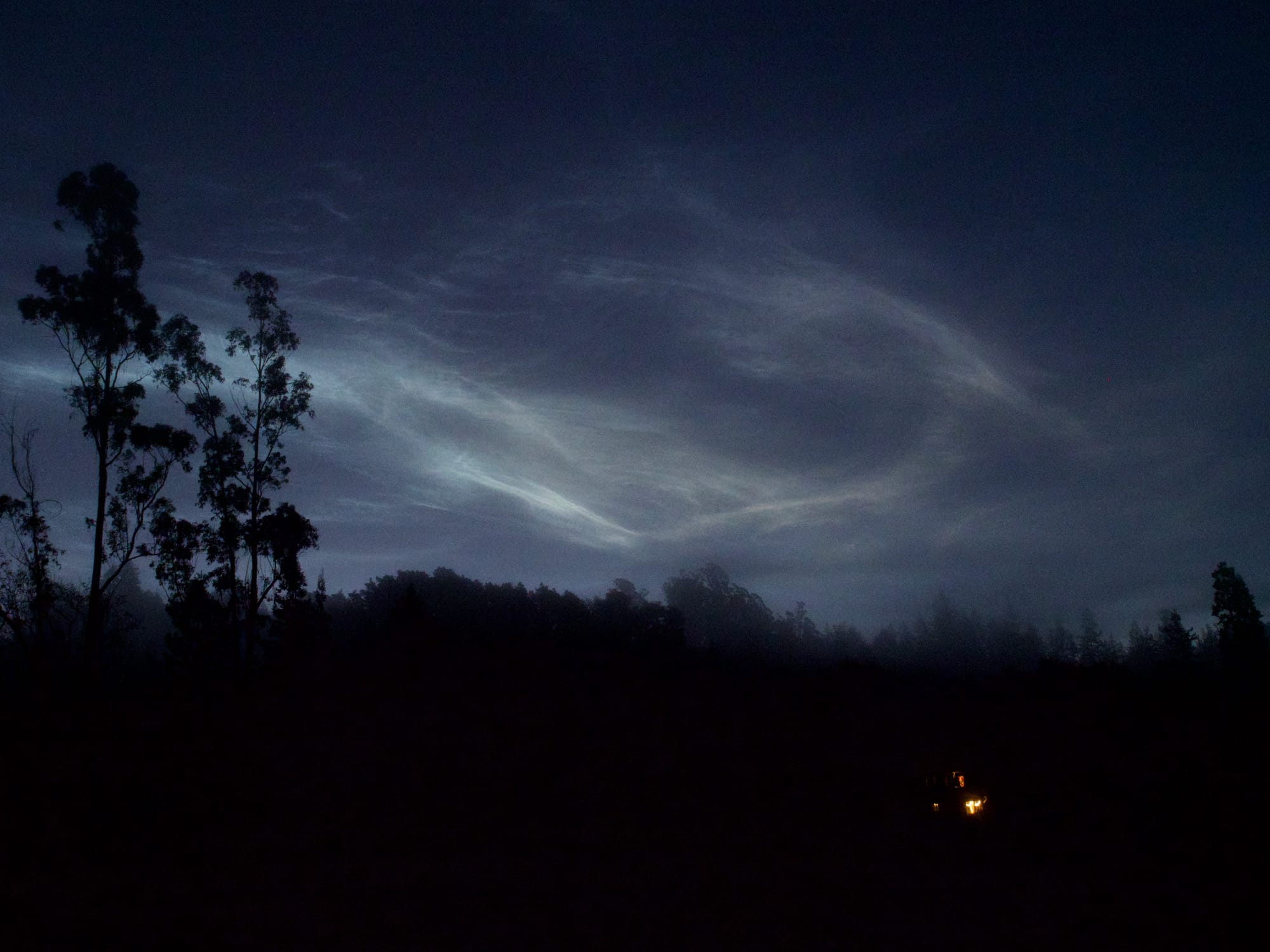
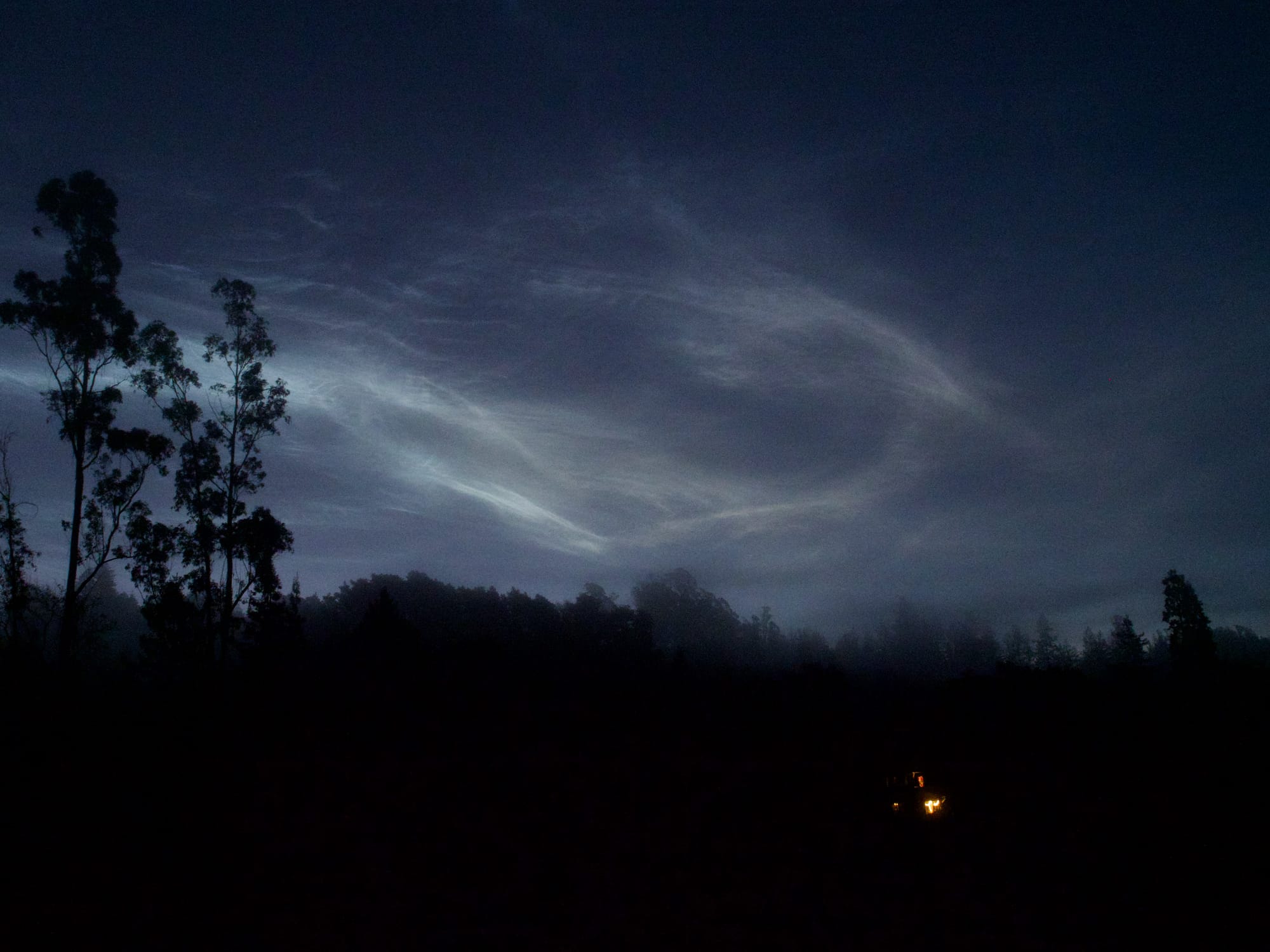
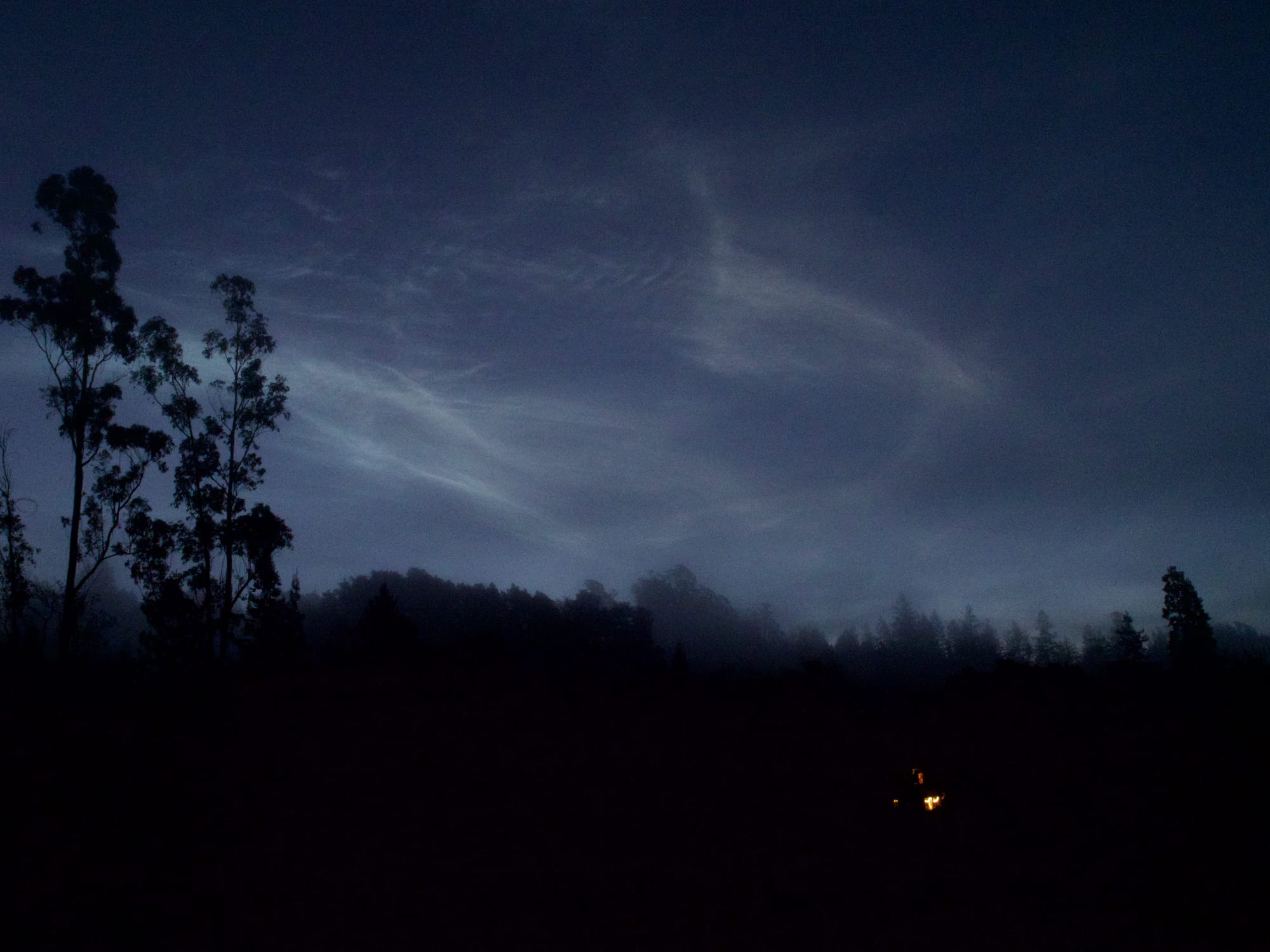
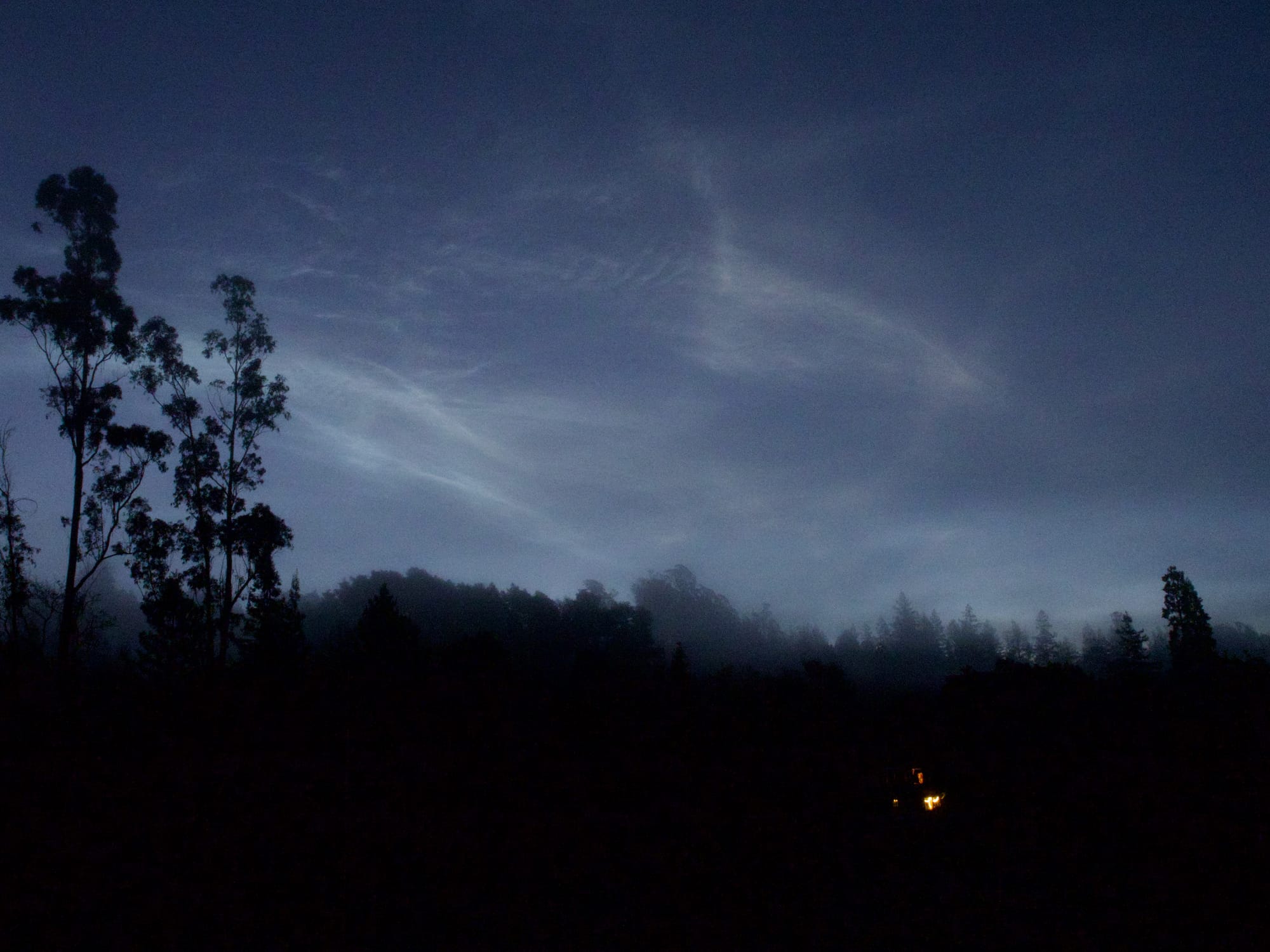
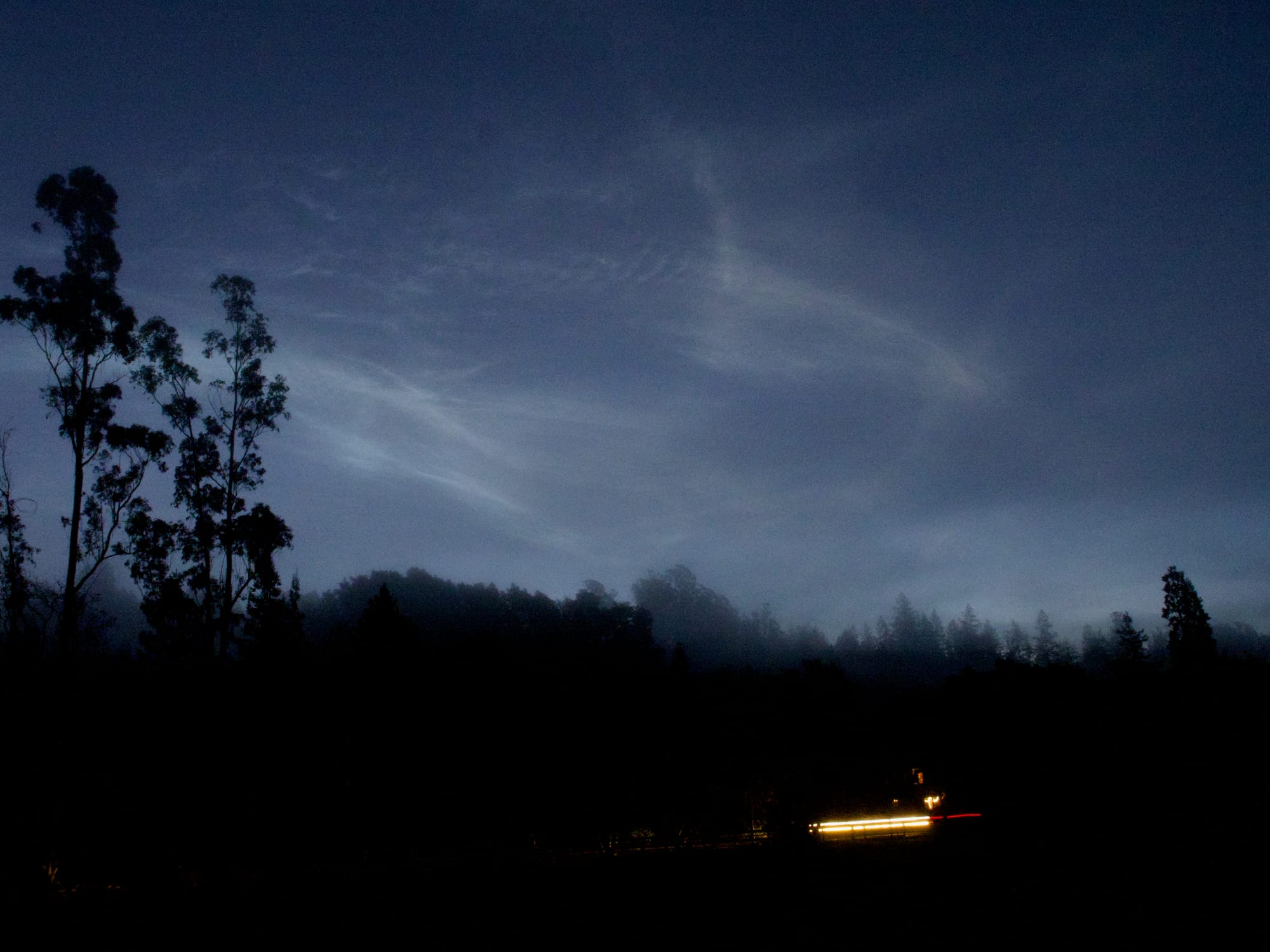
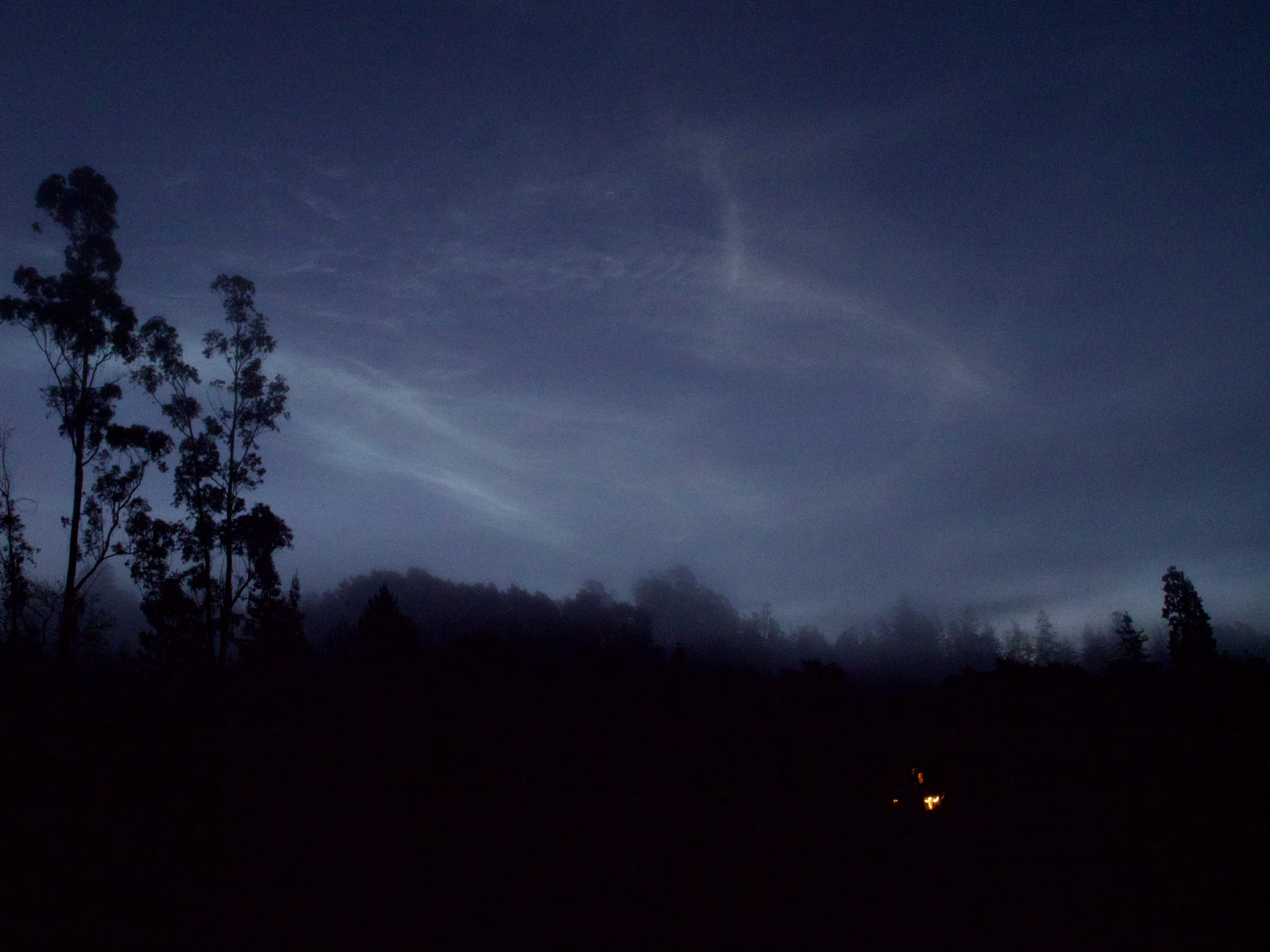
What makes the sequence more than a curiosity is the fixed position and the timestamps. Track how fast the formation changed shape, factor in the known altitude — around 80 kilometres — and you have a rough measure of differential wind shear in the upper mesosphere. A single image records that the event happened. A sequence, from a known point, at known times, records something about the physics.
Like Adams's original, the whale was gone in minutes; unlike the original, it left something behind. I knew the sky was unusual; I hadn't known the photographs were too. Which is, I suppose, the point of looking more closely.
Researched and drafted in collaboration with Claude (Anthropic).