The sound we measure, the harm we don't
It seems like it should be simple enough: “the jets overhead are insufferable,” or “my neighbor is still partying at 11pm” are both perfectly reasonable things to complain about. But when it comes to actually getting something done about them — or whether there is even a basis to do so — things get complicated very quickly.
The first complication is that, although both are complaints about noise, they fall under completely different regulatory systems. But the deeper difficulty is the same in each case: sound can be measured with extraordinary precision, while deciding what the measurement means — and whether it leads to action — is much harder.
If the practical question is “how do I get the noise to stop?”, you have to pass through a series of separate gates: whether the sound has been measured in a way that captures what matters about it; whether the system recognizes the resulting impact; whether that impact crosses a threshold carrying legal or regulatory weight; and whether crossing that threshold actually produces a remedy. And clearing one gate does not guarantee clearing the next.
1. One deceptively simple question is four questions in disguise
The physical properties of sound can be measured in well-defined ways, even if doing so is not always straightforward. Sound pressure level is normally expressed in decibels (dB), a logarithmic rather than linear scale. Environmental noise is very often reported as A-weighted decibels (dBA), which apply a frequency weighting intended to approximate the differing sensitivity of human hearing across the audible spectrum. A detailed explanation of the scale, weighting, averaging metrics and common noise numbers appears in the appendix.
From the big-picture perspective, that's actually comparatively easy: a calibrated instrument can describe a great deal about what happened acoustically. The real difficulty begins with what the measurement means.
A number in decibels does not by itself indicate whether a sound is noticeable over the background, whether it interferes with sleep or conversation, whether it recurs twenty times a day, whether it has a distinctive tone or impulsive character, or whether society considers the interference unreasonable.
A white-noise machine provides an almost perversely simple illustration. Turn one on in a bedroom and a sound-level meter will register more acoustic energy, not less. Yet people deliberately add that sound because a steady, predictable wash of noise can mask the irregular sounds that would otherwise disturb sleep or attract attention. Physically, the room has become noisier. Experientially, it may have become less intrusive. Adding sound can reduce nuisance.
That difficulty comes from collapsing several different questions into the word “noise”:
- Sound — what physically occurred? The measurable acoustic phenomenon.
- Noise — how is that sound experienced in context? Sound that is unwanted, intrusive or otherwise undesirable.
- Effects — what consequences does the exposure produce? Anything from momentary annoyance to long-term physiological harm.
- Nuisance — when does society or the law treat the interference as unreasonable? A legal or social judgment that may justify a remedy.
The categories overlap, but they are not interchangeable. A physiological effect does not depend on a legal finding of nuisance. A nuisance can exist without proof of cardiovascular injury. And calling something “noise” already brings context and human response into what began as a physical sound.
The United States Congress did, however, attempt to define the thing being regulated. The federal Noise Control Act of 1972 defined environmental noise as:
“the intensity, duration, and the character of sounds from all sources.”
That is unusually sophisticated. It does not reduce environmental noise to a single level reading; it explicitly includes how intense, for how long, and what kind of sound.
It would be a mistake to overclaim what Congress did, though. This is a definition of environmental noise, not a complete definition of “noise pollution,” and it does not itself indicate at what point an exposure becomes unacceptable.
The exposure was defined remarkably well. What was never satisfactorily settled was the point at which that exposure becomes pollution — and what follows when it does.
That leaves three distinct steps:
- Measurement: what happened acoustically?
- Threshold: when does that become unacceptable?
- Remedy: what, if anything, is someone empowered or required to do about it?
Those are the gates. Analytically, they reduce to a three-part chain: measurement → threshold → remedy. The arrows are not automatic: a system can measure an effect, recognize that it matters, and still provide no direct route to making it stop. That chain is the thread the rest of the piece follows. The health evidence explains why the threshold matters; the history explains how particular metrics and thresholds arose; and the land/air comparison shows different ways in which the chain can fail.
2. Noise has a measurable health burden
Environmental noise can activate a well-documented physiological stress response, engaging the sympathetic nervous system and hormonal pathways that include the release of cortisol. Those responses, together with sleep disruption, provide plausible pathways by which repeated exposure contributes over time to cardiovascular and metabolic disease. Much of the resulting burden is chronic and spread across a population rather than attributable to one dramatic exposure or one identifiable event.
The psychological effects run alongside the physiological ones, not beneath them. Annoyance, in the technical sense used in the research literature, is not just a fleeting irritation. It is a measurable psychological response assessed through standardized surveys, and public-health burden calculations treat it as an outcome in its own right. Psychological response can also interact with the physiological stress pathways described above. That is why annoyance appears as its own line item in the disease-burden accounting below rather than disappearing into a vaguer “quality of life” category.
Children provide some of the clearest evidence of a distinct cognitive effect. Long-term aircraft-noise exposure around schools has been associated with impaired reading comprehension and aspects of memory, strongly enough that WHO quantified childhood cognitive impairment as a separate component of its 2011 burden estimate.
Nor is subjective annoyance a reliable measure of physiological response. Someone can quite truthfully say that a noise source does not bother them. That indicates something about their conscious experience — not necessarily what happened to their sleep architecture, blood pressure or stress physiology. The distinction is familiar elsewhere in medicine: hypertension can be physiologically important without producing any sensation of “feeling hypertensive.” Individual susceptibility varies, but absence of perceived annoyance does not establish absence of physiological effect.
Some of the most useful data here come from Europe and date back to 2011. They are not a present-day estimate of the health burden in the United States, but the underlying biological mechanisms are not peculiar to Europe, and the figures are useful for a different reason: they show how that burden can be distributed.
A 2011 WHO assessment of western Europe put a figure on that distribution in DALYs — Disability-Adjusted Life Years, a standard public-health measure combining years of life lost to premature death with years lived in less than full health. It estimated annual losses of 903,000 DALYs from sleep disturbance, 587,000 from annoyance, 61,000 from ischaemic heart disease, 45,000 from children's cognitive impairment and 22,000 from tinnitus.
The striking point is not merely the total. It is how much of the quantified burden arose from conditions often dismissed as merely annoyance or disturbed sleep. Those effects may appear less dramatic than a diagnosis of heart disease, but at population scale their cumulative burden can be much larger.
More recent estimates show that the burden remains substantial and that researchers are quantifying a wider range of outcomes. The European Environment Agency's Environmental Noise in Europe 2025 report, using corrected 2021 exposure data, attributes approximately 73,000 premature deaths and 49,000 new cardiovascular disease cases annually across Europe to chronic transport-noise exposure. It also quantifies a metabolic outcome not included in the 2011 WHO breakdown: about 23,000 new cases of type 2 diabetes each year. Across all categories, the EEA estimates roughly 1.5 million healthy life years lost annually, with almost 16.9 million Europeans experiencing long-term high annoyance and about 4.6 million severe sleep disturbance.
None of this requires every case of cardiovascular disease, diabetes or disrupted sleep to be traced back to one identifiable noise event. Like air pollution or secondhand smoke, the burden is detected statistically across populations. That is enough to establish a public-health effect without pretending that any particular person's illness can be assigned to one aircraft, one road or one noisy night.
The science and the methods used to quantify its effects have continued to develop. WHO issued new evidence-based environmental-noise guidelines in 2018, after systematic review of the accumulated research. In 2024 it published updated disability weights for noise-related health states, including annoyance and sleep disturbance.
The evidence base has kept moving. The regulatory metrics and thresholds built on top of it, as the next sections show, mostly have not.
3. Regulators understood the problem in the 1970s — then the architecture largely froze
Any fair account of the regulatory architecture that follows has to start by crediting the early regulators who built it. The 1972 statutory definition already recognized intensity, duration and character — a genuinely sophisticated formulation for its era. Other regulatory approaches also tried to account for more than raw loudness. Sonoma County, California — used as a convenient example throughout this piece — is a case in point: its General Plan Noise Element adjusts some standards for existing ambient conditions and for tonal, speech or music, repetitive, or impulsive sounds in new projects.
That doesn't mean nothing went wrong. The critique that follows is not that early regulators were ignorant of context — it is almost the opposite: they understood that context and character mattered — but that the rules haven't kept pace with the science since.
The aviation metric is a yearly average of aircraft noise alone
The FAA's primary metric for cumulative aircraft-noise exposure is Day-Night Average Sound Level — DNL. DNL is an A-weighted average based on sound energy over a midnight-to-midnight period. Sound occurring between 10 p.m. and 7 a.m. receives an extra 10-dB weighting.
The same formula can be used for any source of sound. What distinguishes the DNL used in FAA aircraft-noise analysis is which sounds are included. Part 150 noise contours and FAA environmental analyses ordinarily represent aircraft noise, not all sound at a location. Noise from roads, industrial activity, wildlife, and other nonaviation sources is not added to the aircraft contours, although the FAA may consider ambient noise separately when describing existing conditions or applying certain land-use provisions.
Part 150 uses yearly DNL, or YDNL. This is the energy average of the daily DNL values over a year, usually modeled from an average day of annual aircraft operations. It is different from the total DNL measured at a location on one particular day. Unless aircraft events are identified and other sounds are removed, a sound-level monitor records everything — aircraft, road traffic, equipment, animals, and other ambient sound. A one-day, all-source field DNL and a modeled yearly aircraft DNL therefore do not measure the same thing.
Three things are worth keeping separate:
- DNL is a metric — a way to summarize cumulative, time-weighted sound exposure.
- DNL 65 is a policy benchmark, and its effect depends on where it is being used.
- DNL 65 is not an enforcement ceiling or a permissible-exposure limit.
Part 150 noise maps must show aircraft-noise contours at DNL 65, 70, and 75 dB. Below DNL 65, every land use is treated as compatible for Part 150 purposes. At or above 65, compatibility depends on the type of land use and, in some cases, how much outside sound a building keeps out.
Participation in Part 150 is voluntary. An airport that does not take part has no Part 150 map or noise-compatibility program, although DNL analysis may still be required as part of an FAA environmental review.
Environmental review uses DNL 65 differently. Reaching 65 does not by itself create a significant noise impact. The proposed action generally must also increase DNL by at least 1.5 dB in a noise-sensitive area that is, or would become, exposed to DNL 65 or more.
The direction of the Part 150 judgment matters. It asks whether residential land use is compatible with the aircraft-noise environment — not whether aircraft have stayed below a noise ceiling.
Those ideas are easily blurred. A resident who hears "DNL 65" may reasonably assume that no aircraft is legally allowed to exceed 65 dB over the resident's house. That is not what the number means. It is not a limit on an individual overflight, an enforceable ceiling, or a pass-or-fail test for a noise complaint.
This framing can produce an unexpected result. A homeowner may look to Part 150 hoping it will require the airport to change its flight procedures. But the airport's noise program may instead leave those operations unchanged and address the home — through sound insulation, an easement allowing continued overflights, purchase assistance, or voluntary relocation. Operational changes are possible, but Part 150 does not give an individual homeowner the right to demand them.
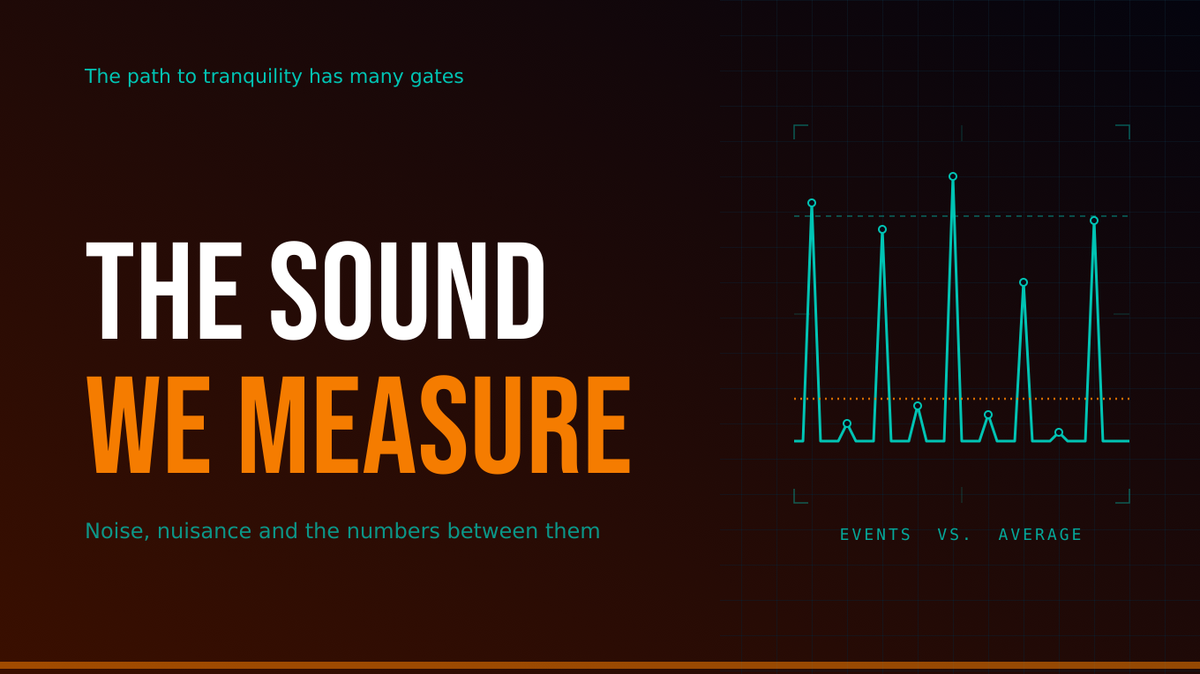
DNL has a separate limitation. It preserves a measure of the total weighted sound energy but hides the pattern that produced it. A single DNL number cannot tell us the loudest event, the number of events, whether they were spread across the day or packed into two hours, whether the sound had a distinctive tone or rumble, what happened between events, or how predictable the events were.
For a resident, averaging is often the central issue. DNL is neither a peak level nor an event count. It rolls the energy from all included aircraft events into one equivalent 24-hour level and gives extra weight to events at night. Many noticeable or disruptive overflights can therefore produce an aircraft DNL below 65, depending on how loud and long they are, how many occur, and when they happen.
Reducing all of that activity to one number makes DNL useful for maps, comparisons, and planning. But the same simplification can make it an incomplete description of the interruptions a resident actually experiences.
EPA: the institution that was supposed to keep looking
In 1974, the Environmental Protection Agency's “Levels Document” identified 55 dB Ldn as the outdoor residential noise level requisite to protect public health and welfare with an adequate margin of safety. Ldn is simply the notation EPA used for the same Day-Night Average Sound Level metric that FAA now calls DNL.
The threshold that remains central to FAA aircraft-noise policy — including as the residential compatibility boundary under Part 150 and in FAA's environmental-review significance test — is 65 DNL. In other words, the two agencies are using the same underlying metric, but FAA's threshold is ten decibels higher. On a logarithmic energy scale, that is not a modest numerical difference: 65 DNL represents ten times the cumulative sound energy of 55 dB Ldn.
The comparison may actually understate the contrast. EPA's 55 dB Ldn figure addressed total environmental noise exposure, while FAA's aircraft DNL ordinarily represents the aircraft contribution alone, without adding the existing background from roads, industry and other sources. The two figures were developed for different purposes: EPA's was not a statutory ceiling, and FAA's is not a permissible-exposure limit. But the underlying metric is the same.
The 1974 Levels Document sat within a broader federal framework created by the Noise Control Act of 1972, which gave EPA continuing responsibilities for identifying and addressing environmental noise. EPA's Office of Noise Abatement and Control was effectively defunded in the early 1980s, while the Act itself has remained on the books.
That historical oddity became legally significant in 2026. In Quiet Communities, Inc. v. EPA, the U.S. District Court for the District of Columbia held that EPA had unreasonably delayed for more than forty years in carrying out several duties that remained mandatory under the Noise Control Act — including reviewing and, where appropriate, updating three major noise reports from the 1970s, and publishing a report on federal noise-research and control activities.
The court rejected EPA’s argument that Congress’s early-1980s funding decisions justified that inactivity, noting that Congress never repealed the Act and that EPA remained able to use its general appropriations to perform those duties. Liability has now been decided; the remedy remains for further proceedings.
That is the hinge this section turns on: the statute anticipated continuing review, but the federal institution responsible for much of that work largely stopped doing it.
4. On land, the County can quantify noise when planning — but ordinary enforcement is another matter
What follows uses California, and Sonoma County specifically, as an example. Other states organize noise planning and enforcement differently; what matters here is what happens inside this particular framework. Fair warning: part of the point is to show how convoluted it becomes.
California law requires every city and county to include a Noise Element in its General Plan, identifying major noise sources and setting a framework for compatible land use. The state commonly uses CNEL — Community Noise Equivalent Level — alongside Ldn for that purpose. CNEL is closely related to DNL: it keeps the same 10 dB nighttime penalty but adds an evening weighting from 7 p.m. to 10 p.m., commonly described as 5 dB; more precisely, the threefold weighting is equivalent to about 4.77 dB. Airport land-use planning in California also makes extensive use of CNEL.
Sonoma County's General Plan Noise Element consequently contains real numerical standards. It can adjust for existing ambient conditions and applies additional penalties to certain kinds of sound — including simple tones, speech or music, and recurring impulsive noise. In other words, the planning system already recognizes something established earlier in this piece: level alone does not capture everything that makes a sound intrusive.
The interesting problem is where those numbers operate. They are principally planning tools: ways to decide whether new development, or a proposed new noise source, is compatible with what is already around it and what mitigation may be required. That is quite different from a generally applicable numerical noise ordinance governing every source already operating in unincorporated Sonoma County.
The County therefore knows how to quantify noise when someone is asking permission to create a new impact. Once an ordinary noise conflict already exists, the path from measurement to enforcement becomes much less direct.
California also has a statewide disturbing-the-peace provision. Penal Code § 415(2) applies to a person who “maliciously and willfully” disturbs another person by “loud and unreasonable noise.” In a jurisdiction without a generally applicable numerical noise ordinance, that can provide one route for an ordinary complaint. But it gives the resident no decibel threshold that automatically establishes a violation. Whether the sound is “loud and unreasonable,” and whether the required intent exists, are legal and factual judgments rather than conclusions a sound-level meter can produce.
County ordinances may provide more specific rules for particular sources or activities, but those protections apply only where their particular provisions reach. And California civil nuisance law supplies another, quite separate route: recurring noise can potentially constitute an interference with the comfortable enjoyment of property. That remedy, however, is ordinarily one the affected resident must pursue through a private civil action, with the cost, delay and uncertainty that entails.
The gap becomes especially conspicuous with intermittent sound. A noise source can be recurring and plainly intrusive without being continuously loud or producing an extreme peak level. Ironically, the County's own planning standards already know how to account for some of those characteristics — ambient context, simple tones, speech or music, recurring impulses — when evaluating a proposed project. There is no comparably straightforward numerical enforcement mechanism for applying the same sort of analysis once an ordinary source already exists.
So there are several distinct legal mechanisms, but they do different jobs. The General Plan is primarily prospective. Narrow County ordinances regulate specified sources or activities. Penal Code § 415 supplies a broadly worded criminal standard rather than a numerical threshold. Civil nuisance can reach recurring interference, but generally requires the affected resident to bring and prove a private case.
Four mechanisms sound like comprehensive coverage. In practice, they leave a significant gap between measurement and remedy. The problem is not that California law has never contemplated intrusive noise, or that any one of these mechanisms is necessarily badly designed. It is that they were created for different purposes and do not form a single, accessible system in which an existing intermittent noise source can be measured against a clear standard and, if it violates that standard, lead to a predictable remedy.
5. In the air, the number exists — but it does less than most people assume
There's a lot to this section, but ultimately it makes one claim in several different ways. Public discussion often treats "65 DNL" as though it were a single, simple pollution limit: below it, safe or acceptable; above it, unlawful. But the phrase actually combines two things: DNL, the metric FAA uses to represent cumulative aircraft-noise exposure, and 65, a policy threshold applied to that metric. Neither does quite what people often assume.
- 65 DNL is not a legal exposure limit.
- The 65 threshold has remained essentially unchanged even as measured community response has shifted.
- DNL compresses concentrated, repeated disruption into a long-term cumulative average.
- FAA's modeled aircraft DNL does not capture how a quiet baseline — such as in a tranquil rural environment — changes the prominence of the same aircraft noise.
- Even when an impact is formally recognized, that does not necessarily give the person affected a right to have it stopped.
- There is a live federal review reconsidering both the metric and the threshold.
One number, several jobs
This section cites two different kinds of federal document, and each does a different job. A regulation is codified law adopted through formal rulemaking. An agency order is different: it sets procedures for how the agency itself carries out its legal responsibilities. A court reviewing an FAA decision can examine whether the agency followed the law and its own procedures, but the order does not operate as a public exposure limit or private noise ordinance.
FAA uses DNL as its principal cumulative aircraft-noise metric, and 65 DNL is an important reference level. That single number gets used by both kinds of document, though, in genuinely different ways.
14 CFR Part 150 establishes the federal framework for airport noise-compatibility planning. It tries to prevent incompatible land uses from being introduced into high-noise areas, but it can also support mitigation for incompatible uses that already exist. What it does not give an individual resident is a private enforcement right: crossing the 65 DNL contour does not itself entitle a homeowner to relief.
For an individual property, being within the 65 DNL contour is ordinarily the basic federal eligibility threshold for mitigation funding — not an entitlement to it — and additional program requirements still apply before measures such as sound insulation or, in some cases, acquisition can receive FAA funding.
FAA Order 1050.1G becomes more directly relevant when the issue concerns a proposed FAA action. The Order sets out FAA's procedures for environmental review under the National Environmental Policy Act (NEPA) — the federal law requiring agencies to consider the environmental effects of proposed actions before making decisions.
A "civil-aviation action" here means an FAA decision such as a new or relocated flight procedure, a new runway or an airspace redesign, rather than growth in operations that occurs without a new FAA decision requiring environmental review. For such an action, the formal noise-significance test is incremental: an increase of 1.5 dB or more is significant at a noise-sensitive area already exposed at or above DNL 65, or if the increase causes the area to reach DNL 65.
That makes the conceptual distinction concrete:
- DNL is the metric.
- 65 DNL is a policy threshold performing several different jobs.
- Neither is a maximum lawful community exposure level, and neither is an enforcement limit against an airline or aircraft.
If a house is exposed to DNL 66, no airline has automatically violated anything: neither Part 150 nor Order 1050.1G sets a per-flight or per-house limit an airline could breach. Aircraft noise is regulated separately through certification standards such as Part 36, which require aircraft types to meet prescribed noise levels under standardized test conditions. That is an entirely different system from limiting what a particular flight may produce over a particular house.
The same number performs several different policy functions, none of them equivalent to a lawful exposure ceiling.
The measured response changed while the threshold stayed
For decades, FAA noise policy has been informed by the Schultz Curve, a dose-response relationship developed from social-survey data available in the 1970s. It related DNL exposure to the proportion of a community expected to describe itself as highly annoyed. FAA's more recent Neighborhood Environmental Survey asked essentially the same empirical question using contemporary aircraft operations and responses from more than 10,000 people living near 20 representative airports.
The result was striking: at the same DNL levels, the new National Curve showed substantially more people highly annoyed than the Schultz Curve predicted. The metric had not changed. What changed was the measured human response associated with a given value of that metric.
That is one of the strongest pieces of evidence for the argument running through this article: even if DNL measures cumulative acoustic exposure exactly as designed, the human response associated with a given DNL value is not fixed forever.
That does not mean DNL itself was simply "wrong." The stronger claim is that a policy relationship built from older community-response evidence should not automatically be assumed to remain a complete representation of current response.
Why averaging matters
DNL is useful for comparing long-term exposure, but the same cumulative value can be produced by very different patterns of sound. Because it is an energy-based metric, there is necessarily a trade-off between two different senses of “volume”: how many aircraft pass overhead, and how much acoustic energy each one contributes.
In the simplest case, ten moderately loud overflights can contribute the same cumulative acoustic energy as one really loud overflight. DNL captures their cumulative energy contribution; it does not preserve the fact that one exposure consisted of ten separate interruptions and the other of one. (For full accounting: this assumes the same time-of-day weighting; and that the single event has has a Sound Exposure Level (SEL) 10 dB higher — a measure of one event's total acoustic energy, explained in the appendix — than each of the ten.)
And those are plainly not the same experience. One person might barely notice the ten moderate events but be jolted or infuriated by one sudden roar. Another might readily tolerate one noisy overflight a day but become frustrated by ten repeated interruptions. Hearing sensitivity, what someone is doing at the time, expectations and the character of the setting can all affect that response. That is a point about experience and nuisance, not a claim that the physiological effects of the two patterns must be identical or follow the same preference.
The white-noise example from section 1 makes the same problem visible from the opposite direction. Adding a steady sound can increase the acoustic energy in a room while making irregular sounds less conspicuous and the room less intrusive. Here, the same cumulative acoustic energy can be divided among events in ways that people experience very differently.
Amount of sound and experience of sound are related, but they are not interchangeable.
DNL answers the cumulative-energy question well. What it does not preserve is the pattern in which that energy arrived: how many separate interruptions there were, how concentrated they were in time, or how conspicuous each event was against the surrounding environment.
That leads back to the distinctions introduced in section 1: intensity, duration, character, recurrence and context can all matter. A cumulative-energy metric captures some of those dimensions well, some only indirectly, and others poorly or not at all.
FAA does not entirely ignore changes below 65 DNL. For airspace and procedure actions it identifies lower increases as reportable in two cases: an increase of 3 dB where existing exposure is between DNL 60 and 65; and an increase of 5 dB where it is between DNL 45 and 60. Reaching those levels can prompt further analysis, including consideration of whether the noise effects could make the proposed action highly controversial.
Those are not significance thresholds, but the distinction is worth sitting with. FAA's own procedures do not actually treat 65 DNL as the point below which nothing counts — the agency tracks and reports changes well beneath it. What changes at 65 is not whether an impact is real, but whether the formal label “significant impact” applies, bringing with it more consequential environmental-review requirements.
Being recognized is not the same as getting relief
There is a broader point here that is easy to miss amid the thresholds and acronyms. Having an impact formally recognized is not the same as having a right to make it stop.
Federal environmental review is largely procedural. It can require FAA to identify an effect, analyze it, disclose it, consider objections and, in some circumstances, undertake a more demanding review. A sufficiently large noise increase can therefore matter a great deal to the process without giving the person underneath it a right to a quieter outcome.
The same distinction appears elsewhere in the system. Being inside the Part 150 noise contour can make a home eligible for mitigation, but does not entitle its owner to it. A change below 65 DNL can be reportable, but reporting it does not require FAA to undo the change. A resident can lodge a noise complaint, but the complaint is evidence and public input, not an enforcement action against an aircraft that has exceeded some legal community-noise limit.
The system contains several ways for noise to be noticed without containing a corresponding mechanism that requires the noise to be removed.
For someone asking the most ordinary question — how do I get this noise to stop? — that distinction is not academic. In many aircraft-noise cases, particularly where exposure remains below the federal significance threshold and operations are otherwise lawful, there is no straightforward individual remedy that compels FAA or an airline to restore the previous acoustic environment.
That does not mean nothing can change. Administrative pressure, political intervention, revised procedures, airport noise programs and litigation over defective agency process can sometimes produce a different outcome. But those are routes by which relief may be achieved, not an enforceable right to quiet.
Baseline-relative noise
Short-term background readings should not be compared directly with annual DNL or CNEL figures as though they were the same metric. But comparable event and background measurements can still illustrate something DNL largely leaves out: contrast.
An aircraft sound contribution of 55 dBA against a 30 dBA rural background stands roughly 25 dB above that background. The same aircraft contribution against a background already near 55 dBA produces much less acoustic contrast. The aircraft sound itself has not changed; its prominence in the surrounding environment has.
A quiet baseline does not mathematically lower the modeled aircraft DNL. FAA aircraft-noise analysis ordinarily calculates the aircraft contribution rather than folding road traffic, birds, wind and other ambient sound into the same number. What the quiet baseline changes is the prominence of each aircraft event. Two places can therefore receive the same modeled aircraft DNL while the aircraft are vastly more conspicuous in one of them. That relative intrusion is largely absent from the DNL number itself.
There is a particularly useful FAA acknowledgment of the underlying principle. Current FAA Order 1050.1G says that the DNL 65 threshold does not adequately address noise impacts on visitors in places such as national parks and national wildlife or waterfowl refuges where other noise is very low and a quiet setting is a generally recognized purpose and attribute.
That is a narrow provision for specially protected quiet places, not a general FAA rule for quiet rural residential areas. But it demonstrates that FAA itself recognizes the underlying acoustic problem: a fixed cumulative threshold can become inadequate when background noise is unusually low and quiet is part of what matters.
That is one reason alternative metrics proposed during FAA's Noise Policy Review are interesting. Community commenters have proposed measures such as N-Above-Ambient+10, which would count events relative to background sound rather than only against a fixed absolute threshold. Its status is important: it remains a proposal submitted to FAA, not an adopted FAA metric or an FAA scientific finding.
The review of the review
Congress required an Aircraft Noise Advisory Committee to examine, among other things, alternative metrics that might supplement or replace DNL and the current 65 dB exposure threshold. FAA established the committee on January 14, 2025, but did not solicit members until July 10, 2026, and has said that further work on its broader Noise Policy Review will await ANAC's recommendations.
The significance is larger than bureaucratic delay. FAA is presently reconsidering the very metric and threshold on which the existing system depends — while communities continue to be evaluated under that existing system.
6. The exposure is defined; the hard part is deciding when it becomes pollution
The question this piece keeps circling back to, in one form or another, is what exactly counts as noise pollution, and when it becomes something for which relief should be available. Government does have a durable statutory definition of environmental noise — intensity, duration and character. What it does not have is a single, coherent definition of the point at which environmental noise becomes “noise pollution” demanding a remedy.
Science can measure the exposure with great precision, and can reveal much more than it could in 1972 about sleep disturbance, annoyance, cardiovascular effects and the importance of context. The unresolved question is what to do with that knowledge: when should measured exposure be treated as unacceptable, and what is anyone obliged or empowered to do then?
On land, Sonoma County possesses numerical planning standards, yet an existing everyday noise conflict may ultimately be judged through broad concepts such as “loud and unreasonable.” A potentially substantive remedy may exist, but there may be no simple standard or accessible enforcement path to reach it.
In aviation, the federal government possesses sophisticated models, numerical thresholds and an elaborate environmental-review process. Yet even a formally recognized impact may principally trigger more analysis rather than a right to a quieter outcome. The chain can therefore fail in different places: the system may inadequately capture the effect, or it may recognize the effect without providing a remedy.
The paradox, then, is not that noise is unmeasurable. Sound can be measured with extraordinary precision. Environmental noise has been understood, for half a century, to consist of more than level alone. What remains unresolved is how to turn that measurement into a defensible judgment about when exposure becomes unacceptable — and then into a remedy someone is actually empowered to provide.
For a reader who arrived here with a less theoretical question — “How do I make the noise stop?” — the present answer may be unsatisfying. In many cases there is no simple route from showing that a noise is intrusive to obtaining an order that removes it. On land, enforcement may depend on a broad judgment about what is “unreasonable,” or on the affected person bringing a civil nuisance case. In aviation, even an impact that FAA is required to notice, analyze or report may not give the person underneath it a right to a different outcome.
The regulatory system offers many ways to complain, document, participate and sometimes challenge. It offers far fewer ways to compel relief.
That is not the same as saying nothing can change. Agencies can change procedures; airport operators can pursue mitigation; elected officials can exert pressure; courts can require agencies to perform duties they have neglected or correct legally defective decision-making. But these are routes by which a remedy may be produced, not a general right held by the person experiencing the noise. Being entitled to have an impact considered is not the same as being entitled to have it stopped.
The health burden does not wait for that regulatory chain to be completed. Sleep is still interrupted. Stress responses still occur. Population-level health burden still accumulates. The scientific evidence has continued to develop; the striking fact is that the measurement-to-remedy framework has not evolved at the same pace.
The absence of a rule that captures an effect is not evidence that the effect is absent. It may simply mean that the thing chosen for measurement is not the whole thing that matters.
This article was researched and drafted in collaboration with Claude, Anthropic's AI assistant.
Appendix — how noise numbers work
The main article only needs enough acoustics to follow the argument. This appendix is for readers who want to know what the numbers actually mean.
A decibel is a ratio, not an ordinary unit
The decibel (dB) is logarithmic. For airborne sound pressure level, the measured sound pressure is compared with a reference pressure of 20 micropascals (20 µPa), conventionally close to the threshold of human hearing around 1 kHz.
The sound-pressure-level relationship is:
Lp = 20 log10(p / p0)
where p is the measured root-mean-square sound pressure and p0 is the reference pressure.
The formula matters less here than its consequence: the scale is not linear.
- 40 dB is not “twice as much sound” as 20 dB.
- An increase of 3 dB represents approximately twice the acoustic energy.
- An increase of 10 dB represents ten times the acoustic energy.
- Two independent sources each producing 50 dB do not add to 100 dB; together they produce about 53 dB.
- Ten similar independent 50 dB sources operating together would produce about 60 dB.
Likewise, 0 dB does not mean no sound. It means the measured sound pressure is equal to the reference level. Under sufficiently quiet conditions, valid measurements can even fall below 0 dB relative to that reference.
Perceived loudness is different again. A common rule of thumb is that an increase of about 10 dB is often experienced as roughly a doubling of loudness, but that is only an approximation. Perception depends on frequency, level, duration, the listener and the character of the sound. Acoustic energy and perceived loudness should not be treated as interchangeable.
Why dBA is not quite the same thing as dB
Human hearing is not equally sensitive at every frequency. At the same physical sound-pressure level, a low-frequency rumble and a mid-frequency tone need not sound equally loud.
An A-weighting filter modifies the measured spectrum to approximate the frequency sensitivity of human hearing, strongly reducing the contribution of very low frequencies and also reducing some high-frequency components. The resulting level is commonly written dBA or dB(A).
That makes A-weighting useful for environmental-noise work, and FAA uses A-weighted sound levels in its principal community-noise metrics. But weighting is itself a form of compression: a complicated frequency spectrum becomes one number.
Two sounds can therefore have the same dBA value while sounding very different. A-weighting can also be less informative for sounds dominated by strong low-frequency content, conspicuous tones or impulses. This is one reason some noise standards apply separate corrections for tonal, repetitive or impulsive character rather than assuming the A-weighted level alone captures the whole response.
For this article, the shorthand is:
dB expresses how sound level is measured; dBA indicates that the frequency spectrum has been weighted toward human hearing. Neither, by itself, indicates whether the sound is acceptable.
Some reference levels — with a warning
Familiar examples help build intuition, but every comparison depends on distance, source, surroundings and exactly how the measurement was taken. These are therefore orientation points, not specifications.
| Approximate level | Familiar example |
|---|---|
| 0 dB | conventional reference near the threshold of hearing |
| 20–30 dB | whisper / very quiet surroundings |
| 40 dB | refrigerator hum |
| 60–70 dBA | ordinary conversation |
| 80–100 dBA | diesel truck passing at roadside |
| 94–110 dBA | jackhammer or pneumatic drill at close range |
| 110–129 dBA | emergency-vehicle siren at close range |
| 140 dBA and above | fireworks or other extreme impulse sounds at close range — at or beyond the threshold of pain, with real risk of immediate, permanent hearing damage |
These examples also show why a sound level should never be quoted without context. “70 dBA” can describe a harmless short exposure, an intrusive recurring event, or part of a much larger cumulative dose depending on duration and circumstances. The top of the table is a different kind of comparison from the rest: it is not primarily about chronic environmental exposure — the subject of the rest of this piece — but about acute acoustic trauma, which can occur from a single event.
The occupational-hearing figure often quoted in public discussion — 85 dBA over an eight-hour workday in the NIOSH recommended exposure limit — is specifically a hearing-loss prevention recommendation for workers. It is not a general environmental-noise threshold for annoyance, sleep disturbance or community health. Different metrics and thresholds answer different questions.
Instantaneous level is only one possible number
A sound-level meter or noise model can produce several different descriptions of the same acoustic environment. They are not interchangeable.
Lmax — the loudest moment
Lmax is the maximum sound level measured during a specified observation period, subject to the meter's time weighting and settings.
It answers a simple question: how loud did it get?
It says little about how long that level lasted or how often it happened.
Leq — the energy-equivalent average
Leq is the level of a hypothetical constant sound containing the same acoustic energy as the actual fluctuating sound over a specified period.
That is different from an ordinary arithmetic average of the displayed decibel numbers. Because decibels are logarithmic, the underlying acoustic energies must effectively be combined before the result is expressed again in decibels.
Leq is useful because it incorporates both level and duration. A brief loud event contributes more energy than a quieter event, while a long sequence of moderate events can accumulate substantial exposure.
But two periods with the same Leq can still sound and feel very different. Ten distinct interruptions separated by quiet intervals can have the same energy-equivalent average as a steadier sound even though the lived experience is not the same.
SEL — compressing one event
Sound Exposure Level (SEL) takes all of the acoustic energy in a discrete event — for example, one aircraft flyover — and normalizes it to a one-second reference period.
SEL is useful for comparing the total acoustic energy of individual events of different durations. It is not the maximum level of the event and should not be read as though the listener actually experienced the SEL value continuously for one second.
L10, L50, L90 — how often a level is exceeded
Statistical sound levels describe the level exceeded for a stated proportion of the measurement period.
- L10 is exceeded 10 percent of the time and tends to reflect the louder part of the sound environment.
- L50 is the median level.
- L90 is exceeded 90 percent of the time and is often used as an indicator of the underlying or residual background level, although whether it is the appropriate definition of “ambient” depends on the regulatory context.
These metrics become particularly useful when the difference between discrete events and the background environment matters — exactly the kind of distinction a single cumulative average can obscure.
DNL — an average day with a nighttime penalty
Day-Night Average Sound Level (DNL, or Ldn) is a cumulative 24-hour energy metric. FAA uses it as its principal metric for community aircraft-noise exposure.
DNL combines the acoustic energy from events across the day and applies a 10 dB weighting to noise occurring between 10 p.m. and 7 a.m. before calculating the equivalent daily level. The extra 10 dB is not a claim that an aircraft physically becomes 10 dB louder at night. It is a mathematical penalty intended to reflect greater sensitivity to nighttime noise and the importance of sleep.
For airport analysis, DNL is commonly expressed for an average annual day, so a year's pattern of operations is represented as an equivalent exposure on a representative day.
DNL therefore incorporates:
- the level and energy of individual events;
- the number of events;
- their timing;
- and extra weighting for nighttime events.
What it does not preserve in an immediately visible way is the shape of the experience: whether thirty events arrived one every half-hour, twenty arrived in a concentrated morning bank, or several occurred against an otherwise very quiet background.
That is why the main article treats DNL as useful but incomplete rather than simply “wrong.”
CNEL — California's close relative of DNL
California frequently uses Community Noise Equivalent Level (CNEL). It is closely related to DNL but adds an evening weighting as well:
- ordinary weighting from 7 a.m. to 7 p.m.;
- +5 dB for noise from 7 p.m. to 10 p.m.;
- +10 dB for noise from 10 p.m. to 7 a.m.
Like DNL, CNEL is a 24-hour energy-average metric. The evening and nighttime additions are mathematical penalties in the calculation, not measurements showing that the physical sound itself became louder.
DNL and CNEL are often numerically close, but they are not identical and should not be silently substituted for one another.
Why “average” can conceal an interruption
Suppose a quiet location spends most of an hour near 30 dBA but is periodically crossed by a much louder aircraft. The resident experiences a sequence: quiet → aircraft → quiet → aircraft.
An energy-average metric answers a legitimate question about the total exposure accumulated over that period. It does not directly answer several other legitimate questions:
- How many interruptions occurred?
- How far above the background was each one?
- How long was each event audible?
- What was the loudest moment?
- Did the events cluster during sleep, conversation or outdoor activity?
- Was the sound tonal, impulsive, low-frequency or otherwise conspicuous?
This is why a statement such as “the annual DNL remained below 65” and a statement such as “the acoustic environment changed dramatically” are not necessarily contradictory. They may simply describe different properties of the same environment.
“Above ambient” and why background matters
Decibels also make the idea of contrast easy to express — provided the underlying measurements are comparable.
An aircraft sound contribution of 55 dBA against a 30 dBA background is 25 dB above that background. The same aircraft contribution against a 50 dBA background is only 5 dB above it. The aircraft sound's absolute level has not changed; its prominence in the local soundscape has.
That does not mean the simple difference between two readings is automatically a complete measure of annoyance. “Ambient” itself can be defined in different ways, and short-term measurements should not be casually compared with annual DNL or CNEL values. But the example illustrates a real acoustic distinction: absolute level and contrast with the existing environment are different quantities.
FAA's own environmental guidance recognizes a version of this problem in specially protected quiet settings, where it cautions that the ordinary DNL 65 framework may not adequately characterize impacts. Community commenters in FAA's Noise Policy Review have gone further and proposed metrics such as N-Above-Ambient+10, which would count events exceeding the ambient level by a stated amount. That proposal is not current FAA policy, but it illustrates how a baseline-relative metric could answer a question DNL does not answer directly.
Event counts answer yet another question
An N-above metric counts the number of events exceeding a chosen level — for example, the number of aircraft events above 60 dBA.
This is intuitively attractive because it describes recurrence directly. But it also requires choosing a threshold, and a fixed threshold recreates the baseline problem: an event at 55 dBA may be very prominent in a 30 dBA environment while disappearing into a much louder urban background.
That is why no single metric is likely to describe every dimension of environmental noise adequately. A useful analysis may need several at once:
- Lmax for peak level;
- SEL for the acoustic energy of individual events;
- Leq/DNL/CNEL for cumulative exposure;
- L90 or another background measure for the underlying environment;
- N-above for recurrence;
- and, where relevant, separate treatment of tonality, impulsiveness or other acoustic character.
The choice of metric is therefore not merely a technical detail. Choosing what to measure is already part of choosing what kinds of harm the regulatory system will be able to see.
Distance matters — but not with one universal rule
For an ideal point source in free space, sound level falls by roughly 6 dB for each doubling of distance. Real environmental sound is more complicated. Ground absorption, terrain, buildings, vegetation, atmospheric conditions, source directionality and reflections can all change propagation. Aircraft add further complications because the source is moving and its power, altitude, geometry and atmospheric path are changing at the same time.
Simple distance rules are therefore useful intuition, not substitutes for actual measurement or appropriate modeling.
The shortest possible translation guide
For readers returning to the main article:
- dB: logarithmic expression of sound level.
- dBA: sound level after A-weighting for the frequency sensitivity of human hearing.
- Lmax: loudest measured level in the period.
- SEL: total acoustic energy of one event normalized to one second.
- Leq: energy-equivalent average over a stated period.
- DNL: 24-hour cumulative level with a 10 dB nighttime weighting; FAA's principal community aircraft-noise metric.
- CNEL: DNL-like 24-hour metric with +5 dB evening and +10 dB nighttime weightings; commonly used in California.
- L90: level exceeded 90 percent of the measurement period, often used as one indicator of background.
- N-above: number of events exceeding a selected absolute or relative threshold.
The central warning is simple:
A noise number is an answer to a particular measurement question. Before treating it as a definition of harm, ask which question it was designed to answer.